
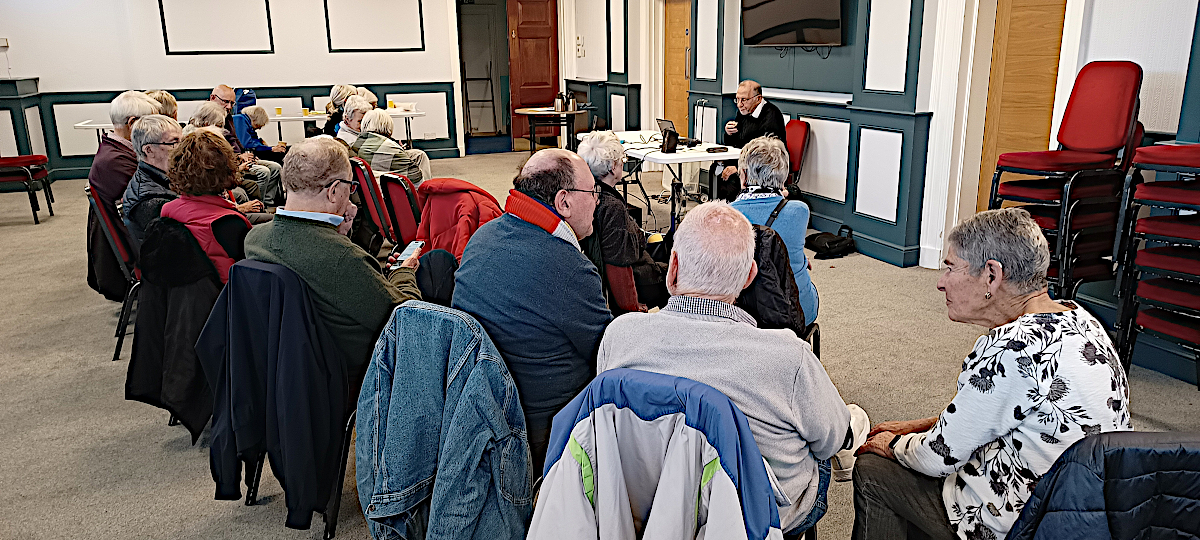
On Thursday 12 November 2026, our Classical Music Appreciation group turned to the life and works of Samuel Coleridge Taylor (SCT). This turned out to be a sad but fascinating story of a musician with enormous talent who died of influenza aged just 37. Our guide, Herbie, had met his daughter at a South Bank Concert in the 1980s.
SCT never met his father, Daniel Peter Hughes Taylor, a native of Sierra Leone who came to the UK to study medicine. He qualified and had a short spell as a GP during which time he met Alice Hare Martin. They had a short relationship before Daniel returned to Sierra Leone after which Alice found she was pregnant. She was taken in by her father who helped raise SCT. Her father played the violin, and in his spare time taught the young SCT to play the instrument. SCT turned out to be a musical child prodigy, and was offered a scholarship to study at the Royal College of Music when he was just 15.
His professor at the Royal College of Music was Charles Villiers Stanford, and he moved from the violin to composition. He excelled at the new field, and was soon composing professionally as well as conducting an orchestra. We heard a religious work “In Thee Oh Lord” composed when he was 16 and still studying at RCM. We then heard his Trio in E Minor, composed when he was 18, and Herbie played the whole piece which lasts just 8 minutes. We also heard part of the Clarinet Quintet which was composed in response to a challenge from his professor, C V Stanford.
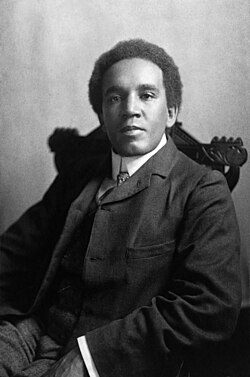
At age 21, he composed his first symphony, and we were able to hear the first movement. His style was balletic and at times quite filmic, although cinema at that time was almost unknown. CVT was befriended by August Jaegar, the publisher for Novello, and was introduced to Sir Edward Elgar. Elgar had been offered a commission for the Three Choirs Festival, but was unable to fulfil the task owing to other commitments. Elgar kindly suggested that the commission be offered to SCT, who composed “Ballade in A Minor” which was well received. Interestingly, although the work was much liked, no recording of a performance existed until 1975!
In 1898, aged just 23, he completed a 3-part oratorio titled “Hiawatha’s Wedding Feast” which was conducted at its first performance by C V Stanford. SCT then travelled to the USA where his music was enthusiastically received. We were able to hear “Onaway, Awake Beloved” from the first part. He progressed becoming more and more popular. In his personal life he married a fellow student from RCM, although her family were initially against the union. They had two children, a boy – Hiawatha Bryan, and a girl Gwendolen Avril. We heard Valse Bohèmienne from Four Charactistic Walzes, and Danse Nègre from his African Suite. In 1912, he was commissioned to write a violin concerto for American violinist Maud Powell. The score was completed, and sent by ship to the USA, but the ship sank. SCT was able to recreate the work from his notes and it was well received.
Whilst returning from another visit to the USA, SCT contracted influenza and died from the disease, aged just 37 with a wonderful career in front of him. Following his death, his widow was left penniless as he had sold the rights to his works in order to get income. It was partly in respect of this that the Performing Rights Society was established, and King George V awarded the widow with a pension of £100 pa – today’s value would be over £12,000 pa.
This was a fascinating story, and it was well illustrated with excerpts and pieces. Our next session will be on Thursday 10 December 2026 at 2:00pm and will look at music appropriate to the season.